

RBT Certification in 2026: Updated BACB Requirements and How to Become an RBT


Interested in becoming a Registered Behavior Technician (RBT)? You're in the right place.
This guide walks through everything you need to know about RBT certification in 2026 and beyond, including the latest BACB requirements, the updated 40-hour training standards, costs, timeline, salary expectations, and each step of the certification process.
RBT Certification at a Glance
Minimum age: 18
Education: High school diploma or equivalent
Training: 40-hour BACB-compliant course
Typical salary: $20-28/hour
Renewal every two years
What is a Registered Behavior Technician (RBT)?
A Registered Behavior Technician (RBT) is a nationally certified paraprofessional who delivers ABA therapy under the supervision of a Board Certified Behavior Analyst (BCBA). RBTs play an invaluable role on the therapy team, typically working 1:1, teaching their learner new skills and behaviors.
What Does a Registered Behavior Technician (RBT) Do?
RBTs implement treatment plan goals as directed by their supervising BCBA. Goals and strategies are individualized to each learner's unique needs. Some of the most common types of goals RBTs work on include:
Communication skills
Replacement behaviors
Social skills
Attending skills
Preacademic skills
Safety skills
Self-advocacy
Activities of daily living (e.g., hygiene, toileting, chores)
Goals are often embedded into play and other daily routines, making therapy enjoyable for both the technician and the client. For example, if a learner enjoys dolls, the RBT may teach communication skills while the two of them play with dolls.
A big part of the RBT's role is data collection. During therapy sessions, RBTs record data on the learner's responses to skill acquisition goals and behaviors targeted for reduction. This information helps the supervising BCBA evaluate progress and make informed treatment decisions.
At the end of each session, RBTs are also responsible for completing a session note that summarizes the services provided. While documentation was once largely paper-based, most organizations now use digital data collection platforms that allow RBTs to record information in real time during sessions. Many providers have also adopted AI-assisted documentation tools to make this task even easier.
How to Become an RBT
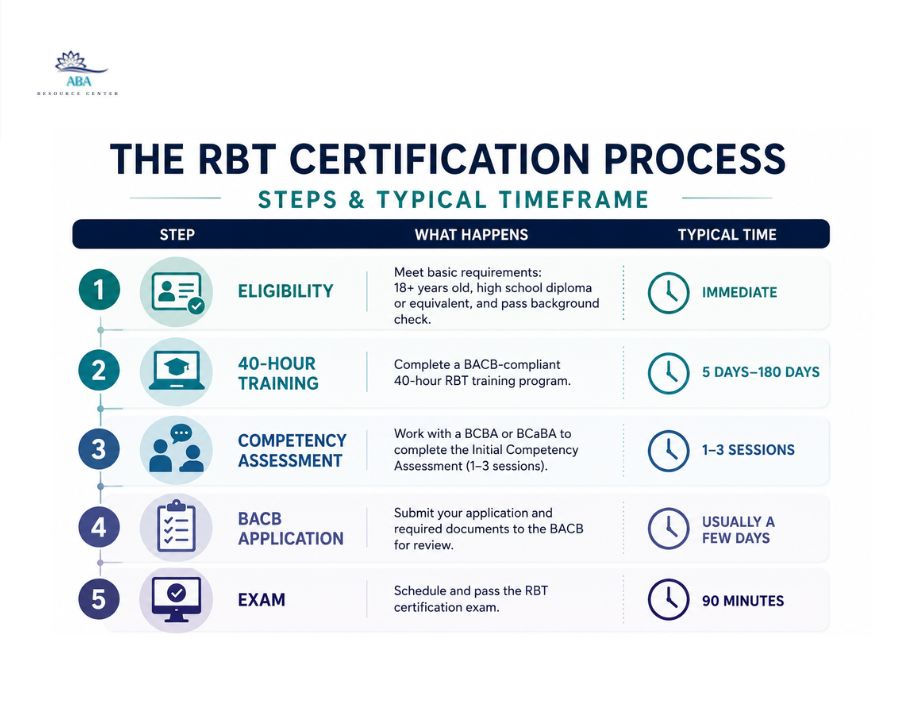
To become a Registered Behavior Technician (RBT), you'll need to meet the certification requirements established by the Behavior Analyst Certification Board (BACB). The certification process includes meeting the eligibility requirements, completing a 40-hour training program, passing a competency assessment, submitting an application, and passing the RBT certification exam.
Most candidates complete the process in a few weeks to a few months, depending on how quickly they complete the required training and schedule their competency assessment.
Becoming an RBT involves five main steps:
Meet the eligibility requirements
Complete a 40-hour RBT training program
Complete the RBT Competency Assessment
Submit your BACB application
Pass the RBT certification exam
Here's what to expect during each step of the RBT certification process.

Step 1: Meet the RBT Eligibility Requirements
Before proceeding, it's important to ensure you meet the basic eligibility requirements. These include:
Be 18 or older
Hold a High School diploma or equivalent
Pass a background check and abuse registry check
Note: The background check will be conducted by the BCBA/company that provides your initial competency assessment.
Step 2: Complete a 40-Hour RBT Training Program
The next step toward becoming an RBT is to complete a 40-hour training program that meets the Behavior Analyst Certification Board (BACB) requirements. This training provides aspiring RBTs with foundational knowledge and skills related to behavior analysis.
There are several options for RBT courses, including online, in-person, or hybrid, allowing candidates to choose an option that best fits their schedule, learning preferences, and budget.
Upon completion, candidates will receive a certificate documenting that they have successfully met the 40-hour training requirement.
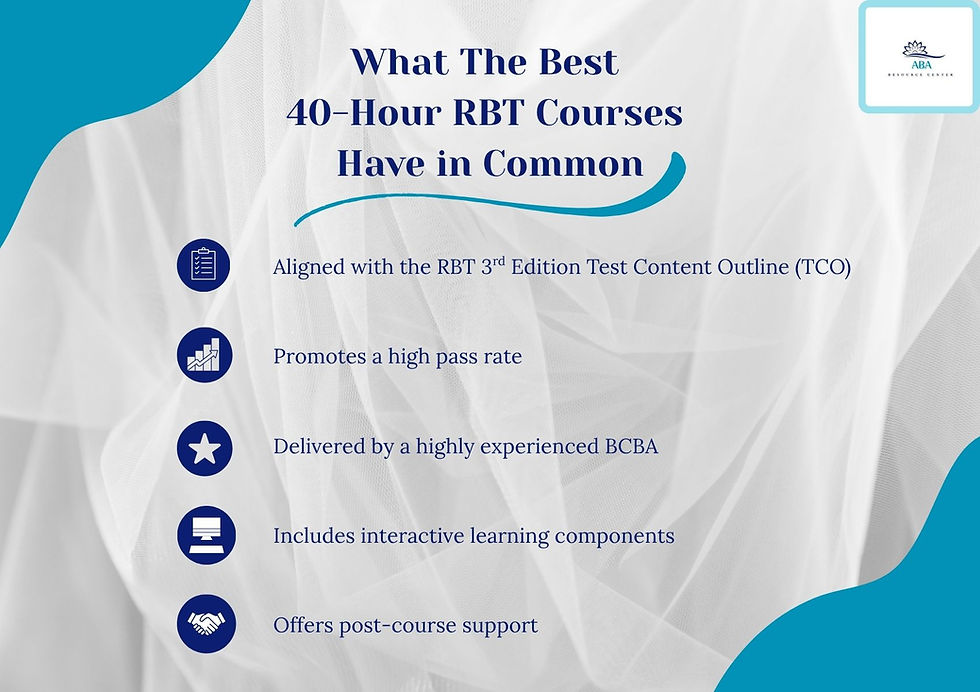
Note: Beginning in 2026, the BACB implemented updated RBT training guidelines. Individuals pursuing certification should verify that any training program they enroll in is aligned with the 3rd Edition RBT Test Content Outline (TCO).
Should You Take the RBT Course Before or After Getting Hired?
The best answer depends on your location and the organizations near you. Many candidates choose to complete the RBT training before applying for behavior technician positions. This may make you a stronger applicant, as it shows initiative. The organization can also potentially move you through onboarding more quickly.
However, it's also common for ABA providers to provide the 40-hour training after hire. If the training they provide is different from the one you took, they may require you to retake the 40 hours to ensure you're trained to their standards.
This tends to be regional. In some areas, ABA organizations require RBT certification prior to hire, meaning aspiring RBTs must pursue it independently. It's important to know this beforehand, so you're not stuck scrambling after completing the course. Because of this, a good first step is always to check out job postings in your area. If companies offer free training, consider applying to organizations that will guide you through the certification process.

Step 3: Complete the RBT Competency Assessment
After completing the required 40-hour training program, the next step in becoming an RBT is the RBT Competency Assessment. This is a hands-on evaluation of a candidate's understanding of some of the main competencies of an RBT.
The competency assessment is conducted by a BCBA or BCaBA who observes the candidate demonstrating specific tasks. Some tasks may be done via interview or role-play with the assessor. However, at least 3 tasks within the assessment must be completed with an actual client.
The BACB requires that the individual completing the competency assessment and the RBT candidate either:
A. Work for the same organization OR
B. Have a contractual relationship that includes the clients who will be part of the assessment.
Because of this requirement, most people complete the initial competency with a BCBA at their job. However, if you're not yet employed as a behavior technician and companies in your area require RBT certification before hiring, you can complete your competency assessment remotely with ATCC or another training provider that offers it. Before enrolling in a course, be sure to verify that the provider is reputable and that its services meet current BACB requirements.
Step 4: Submit Your RBT Application
Once you've completed the 40-hour training and initial competency assessment, the next step is to submit your application through the BACB. During this process, you'll upload:
The RBT Attestation Form, which verifies your eligibility
Your 40-hour training completion certificate
The completed Initial Competency Assessment
The BACB usually processes RBT applications within a few days. Click here to see current application processing times.
If you're approved to sit for the exam, you'll receive a link to schedule your exam appointment through Pearson Vue. If your application is denied, you'll need to make any necessary corrections before moving forward.
Step 5: Pass the RBT Certification Exam
The final step is to take and pass the RBT exam. This exam is designed to assess your understanding of foundational ABA principles and strategies you'll need to succeed in ABA.
The exam consists of 75 questions + 10 pilot questions. Candidates have 90 minutes to complete it, and they'll know whether or not they passed right after submitting it.
Once you pass the exam, you'll officially become a Registered Behavior Technician and be authorized to provide ABA services under the supervision of a qualified BCBA or BCaBA.
Upon passing, you'll initially be listed as inactive in the BACB's registry. This is only until your supervisor lists you as a supervisee. At that point, it'll switch to active.
Related: RBT® Exam: What to Expect
How Long Does It Take to Become an RBT?
You can get fully certified as an RBT in as few as a few weeks, though the exact timeline depends on how quickly you complete each step of the process.
The 40-hour training can be finished in as little as five days or as many as 180 days. After that, the timing of the Initial Competency Assessment often depends on availability with a supervising BCBA or employer. The actual competency assessment doesn't take long and is usually completed in 1-3 sessions.
How Much Does an RBT Make?
The average pay for a Registered Behavior Technician (RBT) can vary based on location, experience, work setting, and whether the position is full-time or part-time. In general, RBTs in the United States earn between $20 and $28 per hour, with positions in higher-cost or high-demand areas paying more.
A majority of RBT positions pay an hourly rate. However, some companies do offer salaried positions with guaranteed hours. The average national salary for RBTs is $45,760 (Clinivise.AI).
Demand for RBTs remains strong across the United States as ABA providers continue expanding services to meet the needs of individuals with autism and other developmental disabilities.
What Skills Make a Good RBT?
While no prior experience is required to become an RBT, certain skills and traits can help you succeed.
Patience
Strong communication skills
Attention to detail
Reliability
Emotional regulation
Adaptability
Openness to collaborate
Frequently Asked Questions About Becoming an RBT
Do You Need a Degree to Become an RBT?
No. The minimum education requirement for RBT certification is a high school diploma (or equivalent). However, many RBTs choose to pursue college degrees in psychology, education, behavior analysis, social work, or other related fields.
Can You Become an RBT Without Experience?
Yes. An RBT is a paraprofessional role that generally does not require prior experience. That said, employers may have their own hiring expectations.
How Hard Is the RBT Exam?
The RBT exam is challenging, but passable. Many candidates find it manageable if they complete a quality 40-hour course and spend time studying before taking the exam.
Can You Take the RBT Exam Without a Job?
Yes. While most candidates take the exam while employed with an ABA company, it's not a requirement. However, the competency assessment portion of the certification process does require an employment or contractual agreement with a company and its clients.
Can't get hired without certification? Get certified with ATCC. They provide both the 40-hour training and the clients for the Initial Competency Assessment.
Is RBT certification worth it?
For many people, yes. RBT certification offers a relatively fast pathway into the ABA field and offers valuable hands-on experience working directly with clients. It can serve as a stepping stone toward advanced credentials such as BCaBA or BCBA certification, and offer excellent experience for future careers in education, psychology, and related fields.
Can you complete the 40-Hour RBT Training online?
Yes. Many BACB-compliant training programs, like AppleTree Connection, are offered fully online.
How long does RBT certification last?
RBT certification lasts for two years. After two years, RBTs must submit a renewal application.
What Is the Difference Between an RBT and a BCBA?
An RBT is a paraprofessional who provides direct ABA services under supervision, while a BCBA is an independent clinician responsible for conducting assessments, developing treatment plans, supervising staff, and overseeing services. Becoming a BCBA requires a master's degree, 1500+ supervised fieldwork hours, and passing the BCBA certification exam.
Where Do RBTs Work?
RBTs most commonly work in clinics, but they can also work in other settings, such as schools, clients' homes, and vocational settings.
Where Can You Find RBT Jobs?
Find an RBT job on the ABA Job Board! LinkedIn and ABA Career Facebook groups are also good sources of open positions.
How Much Does It Cost to Become an RBT?
The costs associated with RBT certification include:
40-hour training: Averages around $100-150
RBT application fee (BACB): $65
Exam fee (Pearson Vue): $45
Note: You'll pay the exam fee for each exam attempt
How many times can you retake the RBT exam?
You have 8 total attempts in a one-year period. So if you fail the exam, you still have 7 chances. If you fail all 8 attempts, you'll need to reapply.
Can you transfer your RBT certification to another state?
RBT certification is a national certification, so it does transfer between states!
Can you work part-time as an RBT?
Yes, there are many part-time RBT positions available. Many students work as RBTs part-time while pursuing higher education.
Is becoming an RBT worth it if you don't plan to become a BCBA?
Absolutely! Not every RBT aspires to become a BCBA, and that's okay! Some RBTs make it a lifelong career. Others eventually pivot to other fields. Experience in an RBT role is valuable for many future career paths.
Becoming an RBT in 2026
Whether you're looking for your first healthcare career, exploring psychology, or planning to eventually become a BCBA, earning your RBT certification is one of the fastest ways to gain hands-on experience in applied behavior analysis.
Ready to get started? Explore what to look for in a 40-hour training program.
Partnership & Transparency Disclaimer
The content we share on ABA Resource Center is reader-supported. This means that if you click on certain links and make a purchase, we may earn a small referral fee. Rest assured, we only recommend tools, resources, and services that we genuinely believe add value to the ABA field.


Once you pass, you will first appear as inactive in the BACB's registry. This remains the case only until your supervisor registers you as a supervisee. Once that happens, it will change to active.
Need a tiny break from the usual work routine? The T-Rex dinosaur game is perfect for those moments when you need to switch your brain off for a minute. It runs directly in the browser on both phone and desktop, so there’s nothing to install. Jump, dodge, and see how far you can go at https://dino-chrome.com
Growing from the smallest cell into one of the largest players on the server is incredibly satisfying. Agario always creates those memorable moments where one smart move completely changes the outcome of the game.