

How to Choose an RBT 40-Hour Training Course: A Complete Guide

If you're beginning to search for 40-Hour RBT training courses—whether for yourself or for your employees—you've likely found there are many options. The challenge is that they’re not all created equal.
RBT training programs can vary significantly in how they deliver content, structure the learning experience, support candidates, and prepare them for real-world practice. This matters because the 40-hour training isn’t just a simple requirement. It’s the foundation for everything that follows, including the competency assessment, exam performance, and day-to-day readiness to work with clients.
This guide breaks down what to look for in an RBT course so you can choose a program that not only meets the minimum BACB requirements but also prepares you or your employees for success in the field of applied behavior analysis (ABA).
What Is an RBT 40-Hour Training Course?
An RBT 40-hour training course is a required step in becoming a Registered Behavior Technician (RBT). It’s the first formal stage in the certification process and must be completed before moving on to the competency assessment and certification exam.
To qualify, the course must meet the requirements outlined in the RBT 2026 40-Hour Training Requirements and Curriculum Outline. RBT training is structured to ensure exposure to core ABA concepts. While programs may differ in delivery format, all approved courses must cover the same required content areas and minimum instructional hours.
Required Content Areas and Minimum Hours
Content Area | Minimum Hours |
Introduction to Applied Behavior Analysis | 2 Hours |
Preparing for Service Delivery | 1 Hour |
Data Collection and Graphing | 3 Hours |
Assisting with Behavior Assessments | 3 Hours |
Behavior-Change Interventions | 20 Hours |
Service Delivery Documentation and Reporting | 3 Hours |
Ethics and Professionalism | 5 Hours |
Next Steps in the Certification Process | 1 Hour |
How Long Does RBT Training Take?
The RBT training takes a minimum of 40 instructional hours. However, most learners complete it in about 42–45 hours when accounting for note-taking, review, and knowledge checks built into the training.
RBT Certification Pathway: Step-by-Step
The following steps outline the process of becoming a Registered Behavior Technician (RBT), from eligibility to certification.
Step 1: Meet the Basic Eligibility Requirements
Before beginning the certification process, candidates must meet the following requirements:
Be at least 18 years old
Hold a high school diploma or equivalent
Pass a criminal background check and abuse registry check (if applicable)
Important Note: Many organizations hire aspiring RBTs before certification and provide training and supervision during the process. However, hiring practices vary by region and employer. In some areas, candidates must complete certification before being hired, while in others, employers actively support certification as part of onboarding.

Step 2: Complete a 40-Hour RBT Training Course
Once eligibility requirements are met, the next step is completing a 40-hour training course aligned with current BACB standards.
As discussed throughout this guide, the quality and alignment of the training program matter considerably. Choosing a well-structured course can directly impact readiness for both the competency assessment and the certification exam.
Step 3: Complete a Competency Assessment
After finishing the training, candidates must complete a competency assessment under the supervision of a qualified BCBA or BCaBA.
This assessment evaluates whether the candidate can demonstrate key skills learned in training. It may include:
Role-play scenarios
Interview-style questions
Direct observation with a client
Important Note: At least three items on the competency assessment must be demonstrated with an actual client. Role-play alone is not sufficient for full completion.
Be cautious of any training provider or BCBA supervisor who offers to sign off on your competency assessment without directly observing client-based performance. This is a major red flag. Noncompliance with BACB requirements could jeopardize your certification application.
Step 4: Submit Application to the BACB
Within 90 days of completing the competency assessment, candidates must apply for the exam. Applications can be submitted directly in your BACB Gateway account.
Step 5: Receive Approval & Schedule the Exam
Once the application is submitted, the BACB reviews the materials. If approved, candidates receive instructions to schedule their exam through Pearson VUE, the official testing provider.
If the application is denied, the BACB provides a reason for the denial. Common issues include:
Completion of a non-compliant or outdated 40-hour course
Failing to meet the required 5-day minimum or exceeding the 180-day maximum training window
Missing or incorrect application information
Errors in documentation
Step 6: Take the Exam
The final step is completing the RBT certification exam. This exam assesses knowledge of applied behavior analysis principles and the ability to apply them to client-based scenarios.
Upon passing, candidates officially earn the Registered Behavior Technician credential and can begin working under BCBA supervision in applied settings.
What to Consider When Selecting a 40-Hour RBT Training
Now that we’ve outlined the steps to become an RBT, it’s important to understand how to evaluate training programs. Not all 40-hour courses offer the same level of quality, and choosing the right one can significantly impact your preparation for both the competency assessment and the certification exam.
Must Be Based on the 3rd Edition RBT Test Content Outline (TCO)
In 2026, the BACB shifted to a new Test Content Outline, the 3rd Edition. With this change, all new RBT applicants must have taken a course that meets the new standards
Some training providers have not yet updated their materials to reflect the new TCO. Taking an outdated course can lead to application issues or delays in the certification process, so verification is essential before enrollment.
When reviewing a course, confirm that it explicitly states alignment with the current Test Content Outline (TCO 3). This information should be listed on the program’s website or course description and should clearly identify the version of the BACB requirements it follows.
Course Pass Rates
When evaluating RBT 40-hour training programs, one important—but often overlooked—factor is course pass rates.
The BACB publishes annual data showing the percentage of candidates who passed the exam by training provider, which really helps to weed out the poor-quality courses.
According to the most recent BACB data, the overall RBT first-time exam pass rate was just 75% in 2025. While many factors contribute to exam success, training quality is a major variable. As such, opt for a course with a high pass rate, ideally 85% or higher.
Instructor Qualifications
Another key factor to consider is who is actually delivering the training. According to BACB requirements, RBT 40-hour training must be provided by a qualified behavior-analytic professional, either a BCBA, BCaBA, or BCBA-D.
Assistant trainers may provide or facilitate parts of the training, but they cannot deliver the training independently. Assistant trainers must have an RBT certification or higher.
You can verify BACB certificants through the BACB registry to confirm certification status.
Course Format + Learning Style
RBT training courses are available in several formats, including self-paced online programs, live virtual cohorts, in-person trainings, and hybrid models that combine multiple learning approaches.
There's no universal "best" format. Instead, consider how you learn best. Self-paced courses are great for those who desire flexibility and convenience. Conversely, live courses provide more structure, accountability, and opportunities to ask questions.

Reputation + Track Record
A training provider's reputation can offer valuable insight into the overall learner experience. Consider reading reviews or discussion posts in online communities, such as ABA subreddits.
Look for patterns in reviews rather than focusing on a single positive or negative comment. Pay particular attention to feedback regarding:
Course quality and organization
Instructor responsiveness and support
Ease of accessing course materials
Technical reliability
Timeliness of certificate issuance
Overall preparedness for the competency assessment and exam
Cost, Additional Features, and Overall Value
Cost is an important consideration for most prospective RBTs and employers. However, it's important to evaluate training programs based on overall value, not just the upfront price.
A lower-cost course may satisfy the minimum training requirement. At the same time, a more comprehensive program may provide additional resources that help candidates successfully navigate the competency assessment, certification exam, and job search process.
It's also worth considering the cost in relation to the course's pass rates. A program that costs slightly more but consistently produces stronger outcomes may provide better value than a cheaper or free option that leaves candidates underprepared and needing to retake the exam.
When comparing programs, think beyond the upfront price and evaluate what's actually included in the training. Does it provide the bare minimum 40-hour course certificate, or does it include additional features such as:
Competency assessment practice
Resume guidance
Post-course employment support
Post-Course Support
Some RBT training programs offer support beyond the 40-hour coursework to help candidates navigate the next step in the certification process: the competency assessment.
This is often where many aspiring RBTs encounter challenges. After completing the training, candidates may realize they still need access to a qualified BCBA to conduct and sign off on the background check and competency assessment. In some cases, securing this supervision can be difficult, especially if local employers require certification prior to hiring.
For this reason, it can be helpful to choose a training provider that offers additional post-course support. Some options include:
Training provider administers the competency assessment: Some training providers offer direct access to competency assessment opportunities or coordinate the process internally. While this is less common among 40-hour training programs and comes with a much higher price tag, this is an option some candidates take.
Employment or placement support: Some providers offer job placement assistance or employer partnerships, helping candidates secure positions where they can complete their competency assessment and continue progressing toward certification.
Why Choosing the Right RBT 40-Hour Training Matters
Selecting the right RBT 40-hour course is more important than many candidates and employers realize. While all BACB-approved courses are designed to meet minimum certification requirements, the quality of instruction, depth of preparation, and level of learner support can vary significantly.
A strong training experience does more than fulfill a requirement. It directly influences how prepared you are for the competency assessment, certification exam, and your transition into your role in ABA.
In contrast, lower-quality programs may create avoidable challenges, including insufficient exam preparation and the need for additional study time or exam retakes. This can also lead to increased financial costs, as each exam attempt requires payment to Pearson Vue. In addition, delays in certification may affect earning potential, particularly if employment or pay increases are contingent on certification.
The RBT certification pathway is sequential. If the foundation is weak, every step that follows becomes more difficult. A solid foundation will help reduce uncertainty and build your confidence to create a fulfilling career in ABA.
What the Best RBT Training Courses Have in Common (Checklist)
The strongest programs tend to share a few key features. When comparing providers, use the following checklist to evaluate overall quality and alignment with BACB expectations.
High-Quality RBT Training Checklist:
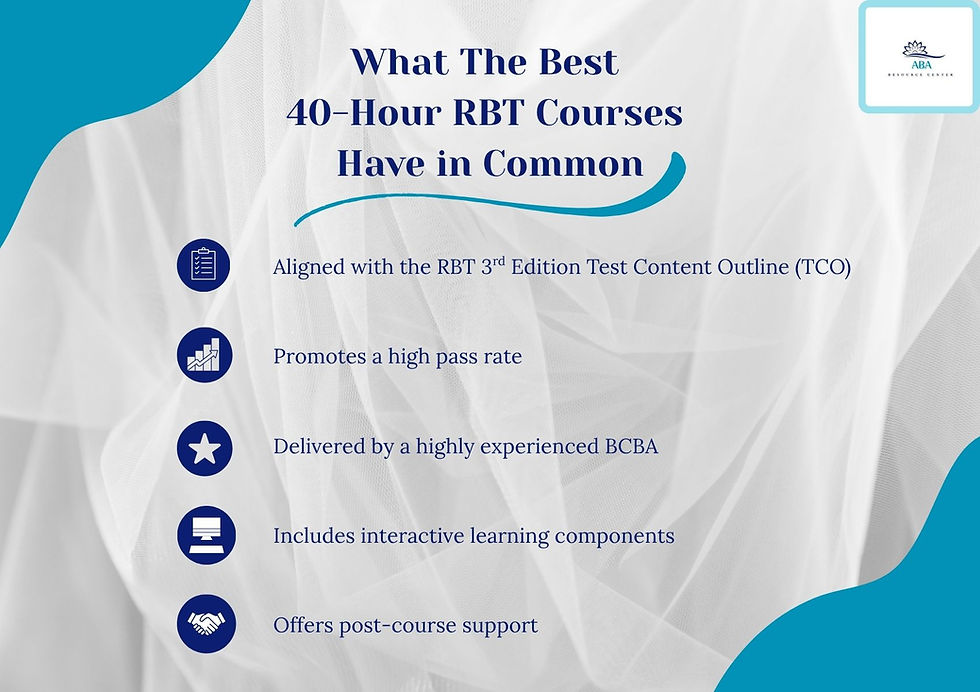
Optional (but valuable) features include:
Study guides, practice exams, or mock assessments
Employment or placement support after course completion
Competency assessment guidance or coordination assistance
Red Flags When Choosing an RBT 40-Hour Training
While most training providers you encounter are likely to be legitimate, be cautious of scammers. Here are a few red flags to watch for.
They promise or guarantee you'll pass the RBT exam: A training program cannot make any guarantees regarding a candidate passing the exam.
They don't show up in the BACB's pass rate reports: You can see every training provider that produced at least 10 first-time RBT applicants here. If the provider doesn't show up, that indicates they're either brand new, didn't have 10 or more students complete the training and apply, or they're not a real course. In any case, proceed with caution.
They ask you to contact them via Telegram or WhatsApp: These apps are commonly used by scammers on social media. A legitimate training program would direct you right to their website to learn more and register.
They don't explicitly reference the test content outline: Be wary of courses that don't have up-to-date information about TCO 3.
The website is vague, unprofessional, or missing key details: Be cautious of RBT training websites that don't outline key details such as course structure, training duration, instructor credentials, and the next steps to certification.
Is RBT Certification Worth It?
For many people exploring a career in ABA, the RBT credential is the most accessible entry point into the field. Earning RBT certification allows individuals to begin working in a high-demand, rewarding field without a major financial or educational commitment.
Start Your RBT Journey
If you're ready to begin your RBT journey, it’s important to choose a training program that sets you up for success from the very beginning. Consider a high-quality course, like AppleTree Connection. They offer multiple modalities, including live cohorts and self-paced course options. With a pass rate above 90%, they're consistently ranked among the top 5 or 6 providers, indicating a comprehensive program that adequately prepares candidates for the exam and, more importantly, for their careers.

Searching for a career as an RBT?
Find your next position on the ABA Job Board, the career board specifically built for ABA professionals.
RBT Course Frequently Asked Questions (FAQs)
What's an RBT?
A Registered Behavior Technician (RBT) is an entry-level provider of ABA therapy. RBTs work under the supervision of a Board Certified Behavior Analyst (BCBA), working directly with learners, teaching them skills, and implementing behavior intervention plans (BIPs).
Can I take the RBT training online?
Yes, many RBT 40-hour training courses are offered online.
Do I need a job as a behavior technician (BT) before taking the RBT course?
No, not necessarily! Many aspiring RBTs take a 40-hour training course, then apply to jobs to complete the next steps of certification. However, going through the certification process with your employer may be easier if that's an option in your area.
What do you do after the 40-hour course?
The next step to earn RBT certification is taking a competency assessment with a BCBA. Most people do this at their place of employment. Learn more about this step in the journey here.
How hard is the RBT exam?
The RBT exam is considered challenging, based on the percentage of exam-takers who don't pass on their first try. However, it's very much a passable exam. Those who take a quality course and spend time studying fare well when taking the test.
What's the difference between RBT and BCBA certification?
RBTs are paraprofessional or entry-level providers that deliver ABA therapy. Their responsibilities include:
Working 1:1 with learners
Following interventions to teach skills (e.g., communication, social, and daily living skills)
Implementing the Behavior Intervention Plan (BIP)
Recording data
Writing session notes
BCBAs are master's-level clinicians who oversee the therapy program, including:
Completing assessments
Creating treatment plans, goals, and programs
Training technicians
Supervising technicians with clients (at least 5% of an RBT's work must be supervised)
How much do RBT courses cost?
The 40-hour training can cost anywhere from $0 to a few thousand. Most courses are in the $100-$150 range.
Does the RBT training certificate expire?
Once you complete the RBT training course and receive a certificate of completion, that does not expire until the BACB creates a new test content outline. For example, in 2026, they released the 3rd edition requirements. At that point, all course certificates earned under the 2nd edition requirements can no longer be used to apply.
What jobs can I get with an RBT certification?
RBTs typically work in autism clinics, ABA therapy centers, schools, and in-home therapy programs. Search for an RBT job here.
Which RBT training program should I take?
There are many options, but we recommend selecting a course like AppleTree Connection for its high pass rates, post-course support, and excellent mentorship.
Partnership & Transparency Disclaimer
The content we share on ABA Resource Center is reader-supported. This means that if you click on certain links and make a purchase, we may earn a small referral fee. Rest assured, we only recommend tools, resources, and services that we genuinely believe add value to the ABA field.


Si può vedere che le affermazioni principali sono costantemente legate a risultati osservabili. Ogni conclusione è presentata con le dovute riserve. Il sito web arricchisce la comprensione del lettore sull'argomento. Le curve di adozione digitale si riflettono nei modelli di attività delle piattaforme.