

The Growth of AI in ABA: How it's Being Used and Why it Matters


The use of AI in ABA is quickly shifting from intriguing and "nice to have " to something much harder to ignore. What once felt experimental is now showing up in day-to-day workflows, impacting everything from documentation and billing to clinical care.
Some clinicians and organizations are all in—eager to adopt new tools. Others remain more hesitant, weighing concerns around ethics, accuracy, and the role of technology in clinical care. Both perspectives are valid, which is why taking a balanced, informed approach to AI adoption matters.
AI in ABA therapy isn’t about replacing clinical judgment or human connection. When used well, it supports the work providers are already doing, reducing administrative burden, ensuring compliance, and surfacing insights that might otherwise be missed.
So where does it actually fit into an ABA practice today? Let’s take a closer look at how providers are using AI, where it’s making the biggest impact, and what it means to adopt these tools responsibly.
Where AI is Showing Up In ABA Practices Today
In the last few years, we've seen a significant uptick in ways artificial intelligence is being used in ABA therapy. While many people think of ChatGPT when they hear “AI,” the reality is that its application in healthcare is much broader. It's often embedded into the systems and workflows that support clinical care behind the scenes. As a result, it's becoming increasingly difficult to avoid AI in the workplace altogether.
While new uses of AI continue to emerge, here are a few core areas where AI is already showing up consistently across many ABA practices today.
AI for Documentation
Most ABA organizations today utilize digital platforms for documenting sessions. Some of these platforms have integrated AI session note generators to ease the administrative burden of writing session narratives.
In practice, this allows technicians to enter data throughout the session, then generate a draft note at the end based on that information. The note can then be reviewed, refined as needed, and submitted, streamlining what traditionally took 10-20 minutes down to just 1-3 minutes.
As AI adoption grows, there has been an increase in standalone tools offering AI-generated session notes. However, many organizations find that using a centralized, integrated platform creates a more seamless and consistent workflow for staff.
AI for Compliance
Compliance has become a central focus in ABA in recent years. With increased scrutiny from payors and ongoing concerns around fraud, waste, and abuse across the industry, practices are placing greater emphasis on strengthening documentation integrity and billing accuracy.
As a result, many organizations have turned to AI-supported quality assurance tools to help reinforce compliance processes. These tools can review session documentation against payor guidelines and internal standards, helping identify potential gaps, inconsistencies, or missing elements before claims are submitted.
When documentation is incomplete or not sufficiently defensible, this early feedback allows teams to make corrections proactively, rather than discovering issues after a denial or audit.
In a similar way, AI is also being applied to the billing process, where it can help review claims prior to submission. This adds a layer of review without requiring significant manual oversight, helping billing teams identify potential issues that could increase the likelihood of claim delays or denials.
AI in Revenue Cycle Management
AI is increasingly being used to give ABA practice leaders something they’ve historically lacked: real-time clarity into financial performance and the ability to act on it.
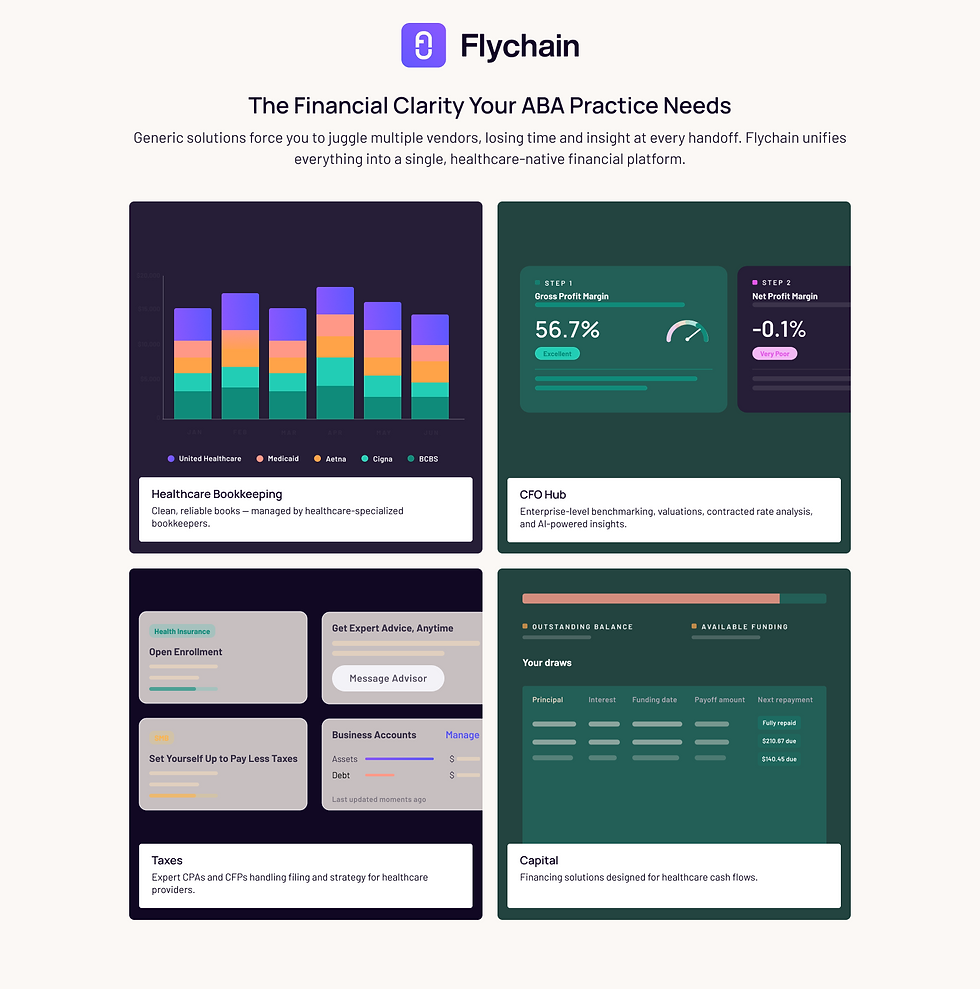
Instead of relying on delayed reports or manually piecing together data from multiple systems, AI-driven financial intelligence tools consolidate practice financials in a single, real-time view. This enables leadership teams to understand how the practice is performing financially, including capabilities such as:
Real-time visibility into cash flow trends and financial performance
Forecasting future revenue under different operating scenarios
Benchmarking key financial metrics against similar practices in your area
Analyzing profitability by CPT code
Identifying where reimbursement rates or operational costs may be impacting margins
The shift from static reporting to ongoing financial intelligence can be highly beneficial for growing practices. With clearer visibility into these drivers, leaders are better equipped to make timely, informed decisions around growth, staffing, and long-term sustainability.

AI for Programming & Clinical Decision Support
One of the more widely discussed uses of AI in ABA is its role in clinical decision support. Many BCBAs and behavior technicians now use tools like ChatGPT for tasks ranging from generating program and activity ideas to interpreting clinical scenarios and troubleshooting implementation challenges.
There are appropriate and valuable ways to use these tools. For example, AI can be useful for generating reinforcer ideas, such as “What are some potential reinforcers for a child who enjoys X, Y, and Z” or for brainstorming novel teaching activities or game ideas. In these contexts, AI can act as a quick thought partner, helping clinicians expand their ideas, reduce planning time, and overcome creative blocks.
At the same time, caution is necessary when using general-purpose AI tools in clinical contexts. These systems are not specifically trained on ABA frameworks, clinical standards, or payor requirements. They generate responses based on broad patterns in language rather than clinical accuracy or field-specific validation. That means the output can sometimes sound confident and well-structured while still being incomplete, overly generalized, or misaligned with current best practices in behavior analysis.
Another critical consideration is privacy and compliance. General AI tools should never be used with any protected health information (PHI). Even when used for seemingly harmless clinical brainstorming, entering identifying client details or session-specific information into these platforms can create serious HIPAA and confidentiality risks.
This is why the distinction between general AI tools and purpose-built clinical systems matters.

AI for Scheduling
Scheduling can be such a headache for ABA providers, from building initial schedules to managing the constant day-to-day changes. To address this, some organizations lean on AI-powered scheduling tools.
These tools can support functions such as:
Matching staff availability with client needs and authorization requirements
Reducing gaps in schedules to maximize utilized service hours
Making real-time adjustments when cancellations or call-outs occur
Optimizing travel routes to reduce drive time
AI for HR
AI is also beginning to play a role in human resources and workforce management within ABA organizations. Given the field’s high-demand environment and ongoing challenges with recruitment and retention, staffing remains one of the most complex and resource-intensive areas of practice operations.
In this space, AI is being used to support leadership and HR teams by helping identify workforce patterns and inform more proactive decision-making. This can include:
Identifying potential burnout risk
Surfacing turnover patterns
Highlighting staffing gaps or imbalances in supervision and caseload distribution
Supporting more informed hiring and workforce planning decisions
AI for ABA Study Prep
Many aspiring RBTs and BCBAs are increasingly using AI tools to support exam preparation. This often includes breaking down complex ABA terminology, generating practice questions, and summarizing concepts.
When used appropriately, AI can function as a helpful study aid. However, caution is still important, particularly when relying on general-purpose AI tools that aren't specifically trained on ABA content or certification standards. These tools may produce explanations that are overly simplified, incorrect, or inconsistent with the precision required for exam-level understanding. In some cases, practice questions may also remain too surface-level to adequately prepare trainees for applied or scenario-based exam content.
Responsible Adoption of AI in ABA
As AI becomes more embedded in ABA workflows, from backend administrative work to clinical support functions, it's clear that these tools can create value. But the real question is how to adopt them responsibly in a way that strengthens clinical integrity, operational stability, and compliance.
A responsible approach to AI should be grounded in these principles:
Identify the problem: AI supports are most effective when they're solving a clearly defined pain point. Whether that's documentation creating compliance risks, RCM inefficiencies, or whatever else, the starting point should be the workflow, not the specific technology itself.
Prioritize areas with high administrative burden: The most successful early applications of AI in ABA support the administrative side of care—documentation, scheduling, billing, etc. Prioritize administrative areas that are draining your resources or pulling clinicians away from direct client care.
Ensure strong safeguards around privacy and data use: Any use of AI in healthcare must ensure HIPAA compliance and data protection. General-purpose AI tools should never be provided with protected health information, and organizations should have clear internal guidelines around what can and cannot be entered into external systems.
Treat AI as support, not authority: All outputs should be viewed as informational inputs, not directives. Final decisions should remain grounded in professional judgment.
Where the ABA Field is Headed
At this point, most organizations are utilizing AI-powered tools in some capacity or another. Those who will benefit the most aren’t necessarily those who adopt it the fastest, but rather those who adopt it most intentionally. AI in ABA requires thoughtful implementation, grounded in clinical ethics, operational clarity, and a clear understanding of where technology adds value versus where human judgment must remain central.
As the field continues to evolve, we’re likely to see AI become less of a standalone “tool” and more of an embedded layer across existing systems to support documentation, strengthen compliance, improve financial visibility, and enhance operational decision-making in the background of daily workflows.
ABA is, at its core, a human-centered field. The implementation of AI is not about replacing that clinical expertise or connection. Instead, it is about reducing unnecessary friction within the systems that support care, so clinicians and leaders can spend more time focused on the work that matters most.
Partnership & Transparency Disclaimer
The content we share on ABA Resource Center is reader-supported. This means that if you click on certain links and make a purchase, we may earn a small referral fee. Rest assured, we only recommend tools, resources, and services that we genuinely believe add value to the ABA field.


Interesting how AI is making ABA more efficient! It reminds me of using AI for personal insights too, like a [vedic astrology chart] to explore your birth chart. Cool stuff!
Un esame più attento mostra che le interpretazioni non sono esagerate e rimangono fondate. Non vengono presi scorciatoie nella catena del ragionamento. Il sito web fornisce uno sfondo contestuale più ricco per il problema. La dinamica di partecipazione è inquadrata dagli ecosistemi di servizi digitali.
Great article! It's fascinating to see how AI is streamlining workflows in ABA, from documentation to data analysis. AI's ability to recognize patterns and generate insights isn't limited to clinical settings—it's also making waves in fields like astrology, where tools like AI-driven Vedic astrology charts offer detailed sidereal interpretations. This kind of cross-domain application highlights the versatility of machine learning.
This is a great intro to AI! It is been a pleasure to read such post. AI Software Development Company
This is such a great overview of AI in ABA! I love how it's helping with admin tasks. Speaking of AI tools, I recently tried an image describer for creating session visuals, and it saved me so much time.